
Do You Need a Panel Upgrade for an EV Charger or Heat Pump?
By Jonah Chegarnov ChegTech
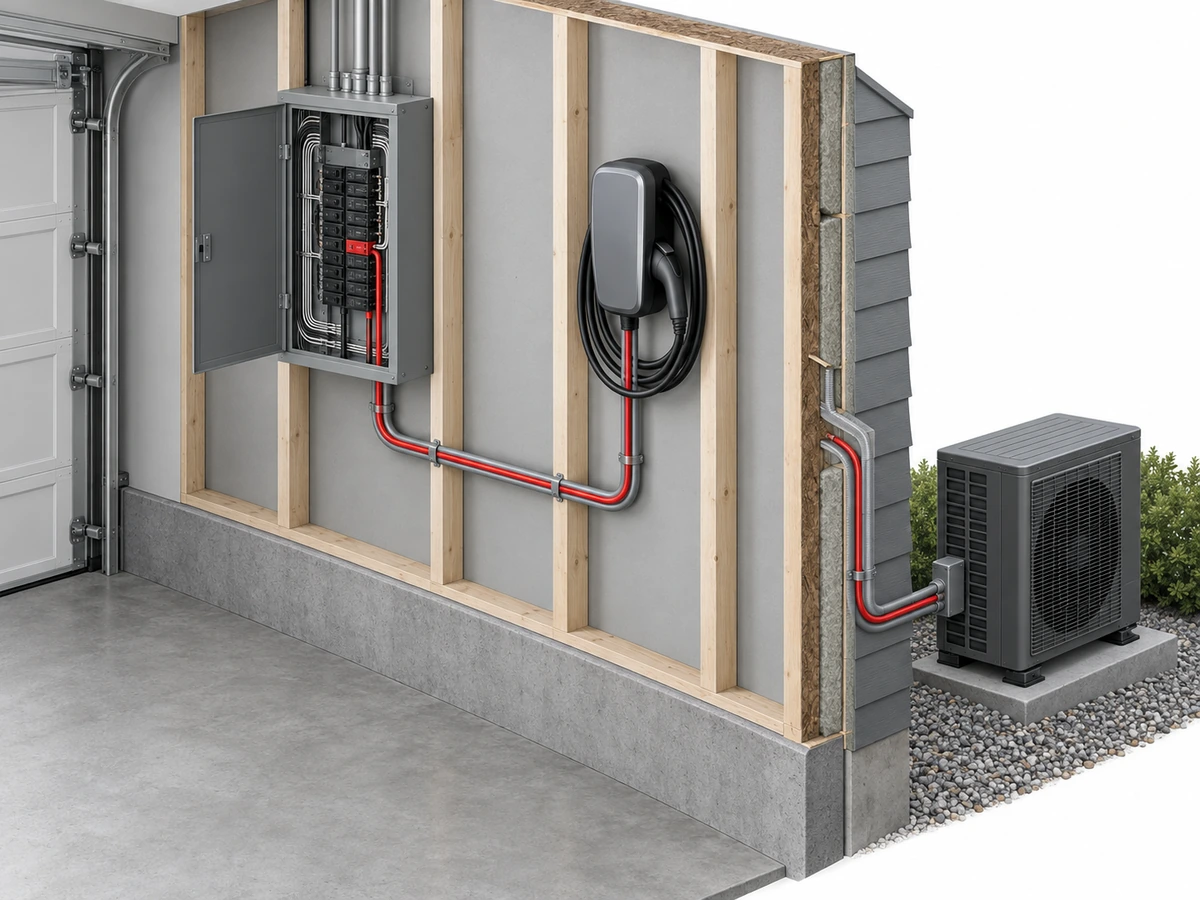
Not always. Whether a home needs a new panel for an EV charger or a heat pump depends on the size of its electrical service, what already runs on it, and whether a load-management device can share the capacity. The way to find out is a load calculation. Under the 2023 National Electrical Code, which Washington currently enforces, that calculation counts a home EV charger at 7,200 watts or its nameplate rating, whichever is higher.
The question comes up far more often in King County than it used to. The Washington State Department of Licensing counted 12,421 electric passenger vehicles registered in the county at the end of January 2017. By January 2026 the count was 134,814, and by August 2026 electric vehicles made up almost 10 percent of the county’s registered passenger vehicles.
Electric passenger vehicles registered in King County
View the data
| Period | Value |
|---|---|
| 2017 | 12,421 |
| 2018 | 16,484 |
| 2019 | 23,817 |
| 2020 | 30,772 |
| 2021 | 36,084 |
| 2022 | 46,715 |
| 2023 | 62,214 |
| 2024 | 89,057 |
| 2025 | 114,547 |
| 2026 | 134,814 |
What actually uses your panel’s capacity
The rating on your main breaker is the size of your electrical service, and everything in the house shares it. The loads that matter are the ones that run for long stretches or make heat: an electric range, dryer and water heater, a heat pump or air conditioner with any electric backup heat, and now an EV charger.
An EV charger differs from most of those in one way. It can run for hours without a break, and the NEC treats charging equipment as a continuous load, so the circuit and the service have to carry it for that long without overheating or tripping. A heat pump brings a different change: if it replaces a gas furnace, it adds an electric load in the coldest months, and electric backup heat adds more on top.
How an electrician decides
A load calculation adds up the house’s existing loads using the NEC’s rules and compares the total to the service size. Washington enforces the 2023 NEC today, and L&I says the 2026 edition replaces it on December 31, 2026. For EV charging, the 2023 edition counts the charger at 7,200 watts or its nameplate rating, whichever is greater. At 240 volts, 7,200 watts is 30 amps.
If the total leaves room, the charger or heat pump goes on a new dedicated circuit and the panel stays. If it does not, there are options to check before replacing the panel.
Options short of a new panel
- Set the charger to a lower current. Many Level 2 chargers can be dialed down, and the code makes provisions for adjustable settings, so a lower setting can bring the calculated load down. The car charges more slowly, which is often fine overnight.
- Add an energy management system. The code also makes provisions for systems that hold the charger back while the rest of the house is drawing heavily, so the total stays within what the service can carry.
- Start with Level 1. The U.S. Department of Energy describes Level 1 charging as a standard outlet on a dedicated branch circuit. It adds range slowly, but for a car that does not cover many miles a day it can be enough.
When a new panel is the right call
- The load calculation shows no room, even with a lower charger setting or load management.
- The panel has no open slots for new breakers.
- The panel shows warning signs: breakers that trip repeatedly, a warm or buzzing cover, scorch marks, or a known problem brand such as Federal Pacific or Zinsco.
If a heat pump and an EV charger are both on the list for the next couple of years, run them through one load calculation. Sizing the service once avoids reworking the panel twice. The electrical panel upgrades page covers what a service upgrade involves.
Who issues the permit in Renton, Kent and Bellevue
Washington requires an electrical permit for most electrical work, and L&I is explicit that whoever does the work pulls the permit. A homeowner cannot buy one on a contractor’s behalf. The inspection has to be requested before the work is covered, and no later than 3 business days after it is finished or 1 business day after any part of it is energized, whichever comes first.
Which office issues the permit depends on the city. L&I lists the cities that run their own electrical permits and inspections:
| City | Electrical permits and inspections |
|---|---|
| Renton | City of Renton |
| Bellevue | City of Bellevue |
| Tukwila | City of Tukwila |
| Seattle | City of Seattle |
| Kent | Washington L&I |
| Auburn | Washington L&I |
| Newcastle | Washington L&I |
Planning the work
Westside Comfort Solutions does both the electrical and the heating and cooling side of these projects, so one load assessment can cover the charger, the heat pump and the panel together. It installs Level 2 chargers of any brand. See EV charger installation and heat pump installation, or, in Kent, start with residential electrical service in Kent. To have your panel checked, get in touch.