
Repair or Replace Your Furnace, AC or Heat Pump?
By Jonah Chegarnov ChegTech
Repair the system if it is younger than ENERGY STAR’s replacement guideline, the fix is a modest share of what a new system costs, and its refrigerant is still available. Lean toward replacing when the system is past that age and repairs keep coming, when a major part fails on an older R-22 unit, or when a gas furnace has a cracked heat exchanger.
ENERGY STAR’s guideline is short: consider replacing a heat pump or central air conditioner once it is more than 10 years old, and a furnace once it passes 15. Treat those ages as the point to run the numbers, not as an expiration date. A well-maintained unit can outlast them, and a neglected one can fail well before.
When ENERGY STAR says to consider replacing
View the data
| Item | Value |
|---|---|
| Heat pump | 10 years |
| Central air conditioner | 10 years |
| Furnace | 15 years |
Start with the diagnosis, not the quote
A lot of “you need a new unit” recommendations skip the step that matters most: finding out exactly what failed. A bad capacitor, igniter or flame sensor is a small repair on almost any system. A failed compressor on a 14-year-old air conditioner, or a cracked heat exchanger in a furnace, is a different conversation. Until the failed part is identified and priced, any talk about replacement is a guess.
Ask for the specific part, the repair price, and what else on the system looks worn. That gives you the three numbers the rest of this decision runs on: the system’s age, the repair cost, and the likely cost of the next repair.
What the 10 and 15 year marks are based on
ENERGY STAR ties its guideline to efficiency. Replacing an older heat pump or air conditioner with an ENERGY STAR model can cut heating and cooling costs by up to 20 percent, according to ENERGY STAR, and it puts a certified furnace at 15 percent more efficient than a conventional one. Past those ages, a repair buys you more years of a less efficient system.
ENERGY STAR also lists signs that point toward replacement whatever the age:
- Repairs are getting more frequent and energy bills keep rising.
- Some rooms run too hot or too cold.
- The house has humidity problems in summer or winter.
- The system is noisy or pushes a lot of dust.
Check which refrigerant your system uses
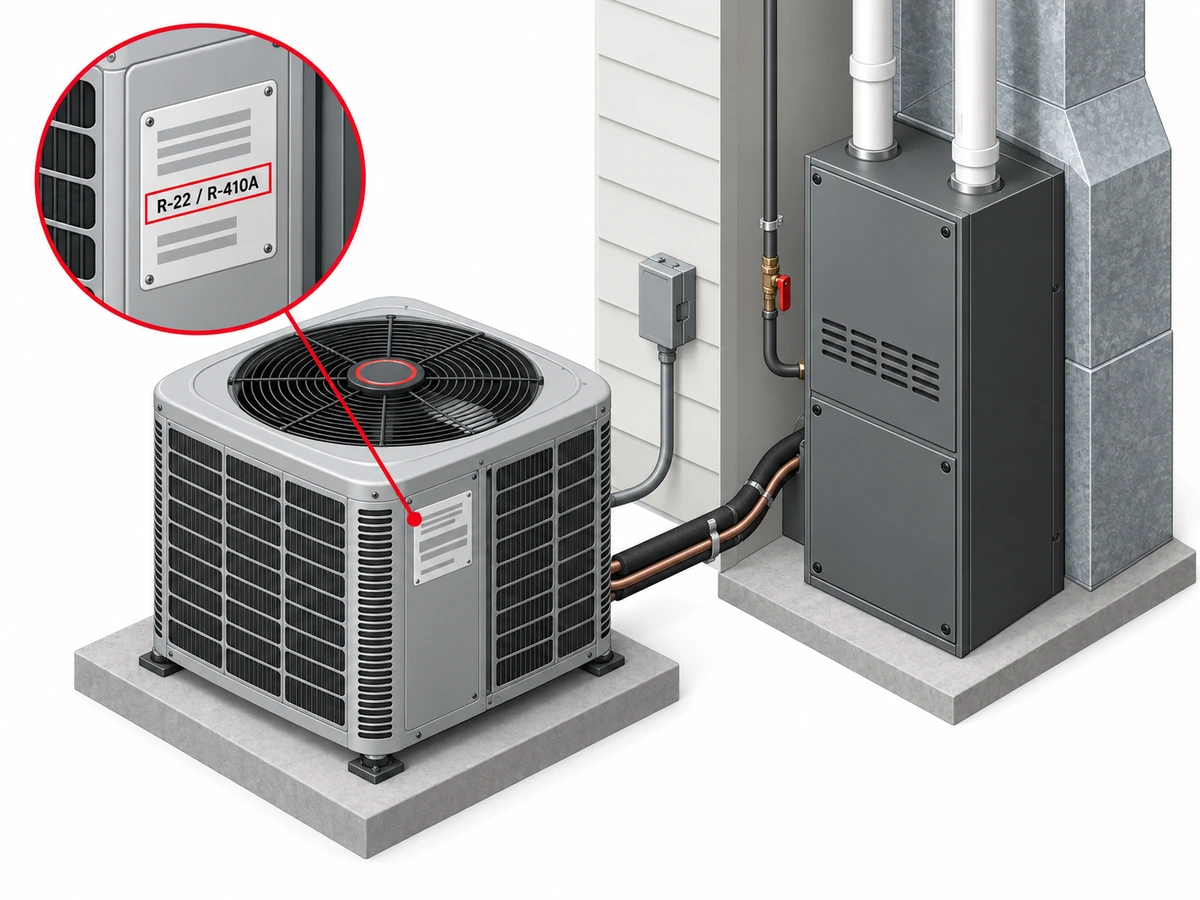
The refrigerant is printed on the outdoor unit’s nameplate, and it changes the math more than most people expect.
| Refrigerant | Where you find it | What it means for a repair |
|---|---|---|
| R-22 | Older air conditioners and heat pumps | No new R-22 has been made or imported in the U.S. since January 1, 2020. Service relies on reclaimed R-22 and pre-2020 stock. There is no drop-in substitute. |
| R-410A | Most newer systems installed before 2025 | Existing systems can keep being serviced. EPA rules limit new residential systems to refrigerants under 700 GWP, but equipment built before 2025 can still be installed. |
| Lower-GWP refrigerants | New residential systems built from 2025 on | Meet the EPA’s 700 GWP limit for new residential air conditioning and heat pumps. |
For an R-22 system, a small repair that does not open the refrigerant circuit is still reasonable. A large leak or a failed compressor is usually where replacement starts to make more sense, because the refrigerant now comes only from reclaimed supply and there is no simple conversion.
What a new system has to meet
Since January 1, 2023, new central systems have to meet higher federal minimums, and Washington falls in the Department of Energy’s North region. In that region, a new split-system air conditioner must reach at least 13.4 SEER2, and a new split-system heat pump at least 14.3 SEER2 and 7.5 HSPF2. Nothing in the rule forces you to replace a working system.
SEER2 comes from a newer test procedure, so the DOE notes it is not directly comparable with the SEER number on an older unit’s label. When you compare quotes, compare SEER2 to SEER2.
If the air conditioner is the part that failed, price a heat pump alongside it. A heat pump cools the same way an air conditioner does and also heats. ENERGY STAR says it can deliver up to three times more heat energy than the electricity it uses. That matters here: the DOE puts Washington in its North region because the state sees 5,000 or more heating degree days a year.
Two rules of thumb, and where they stop working
Contractors often use two quick checks. Neither is a standard, and both are only as good as the repair price you plug in.
The first is the 50 percent rule: if one repair costs more than half the price of a new system, replacement usually wins, especially past the ages above. The second multiplies the system’s age by the repair price. A result over 5,000 generally points toward replacement, and a result well under it points toward repair.
One case ignores the math. A cracked heat exchanger in a gas furnace can leak carbon monoxide into the house, so the answer is replacement whatever the age or cost.
Questions to ask before you decide
- What exactly failed, and what does the repair cost?
- How old is the system? The model and serial plate will tell you.
- Which refrigerant does it use?
- What else on the system is showing wear?
- If you replace it, would a heat pump fit the house?
- Is the new system sized with a load calculation, or matched to the old one?
Getting a straight answer
Westside Comfort Solutions diagnoses the fault before quoting anything and will tell you when a repair is the better use of your money. If your system is struggling, start with furnace repair or AC repair. If replacement is on the table, see what goes into furnace installation and heat pump installation, or get in touch for a diagnosis.
Sources (5)
- When is it time to replace?
- Homeowners and Consumers: Frequently Asked Questions (HCFC-22 phaseout)
- Technology Transitions HFC Restrictions by Sector
- 2023 Energy Conservation Standards for Residential Central Air Conditioners and Heat Pumps: FAQ
- Consider a Heat Pump to Replace Your Central Air Conditioner