
Adding Air Conditioning to a Puget Sound Home
By Jonah Chegarnov ChegTech
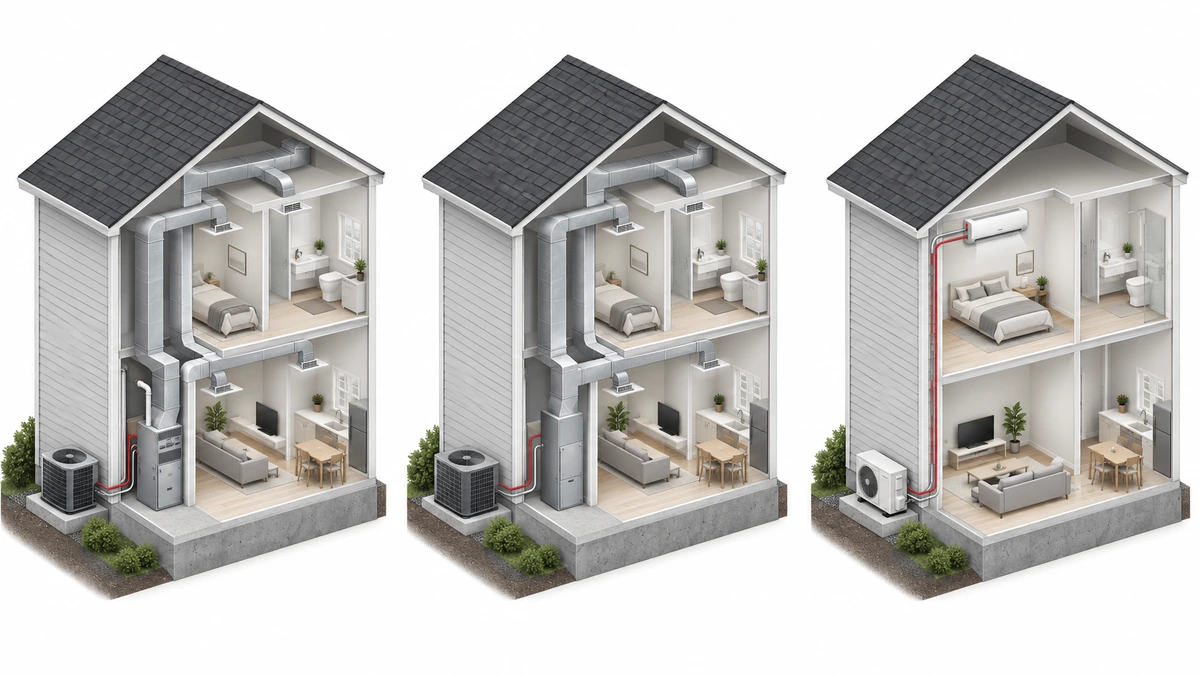
If your home has ductwork, the usual choices are a central air conditioner or a heat pump that uses the existing ducts. If it does not, a ductless mini-split is usually the cleanest way to cool it. In this climate a heat pump is worth pricing either way, because the same equipment also heats.
More Puget Sound households are making that call. The Census Bureau’s American Housing Survey found air conditioning in about 31 percent of Seattle-area homes in 2013, 44 percent in 2019 and 53 percent in 2021, as reported by Cascade PBS and KUOW. The survey’s Seattle area covers King, Pierce and Snohomish counties.
Seattle-area homes with air conditioning
View the data
| Item | Value |
|---|---|
| 2013 | 31% |
| 2019 | 44% |
| 2021 | 53% |
The June 2021 heat wave explains a lot of the jump. Seattle reached 108°F on June 28, 2021, an all-time record for the city, according to NOAA. In the previous 126 years Seattle had hit 100 degrees only three times, and that week it did so three days in a row.
The same survey shows who has caught up and who has not:
| Seattle-area homes with AC | 2013 | 2021 |
|---|---|---|
| Owner-occupied | 39% | 62% |
| Rented | 18% | 41% |
Option 1: central air conditioning on existing ducts
If the house has a forced-air furnace, central AC adds an outdoor condenser and an indoor coil at the furnace, and uses the furnace’s blower and ducts to move cool air. It only cools. Since January 1, 2023, a new split-system air conditioner installed in Washington must reach at least 13.4 SEER2, the Department of Energy’s minimum for its North region.
Central AC makes the most sense when the furnace is fairly new and you want cooling without changing how the house heats. See AC installation for how an install runs.
Option 2: a heat pump on existing ducts
A heat pump sits in the same place as a central air conditioner and cools the same way. In winter it runs in reverse and heats. ENERGY STAR says it can deliver up to three times more heat energy than the electricity it uses. A new split-system heat pump in Washington must meet at least 14.3 SEER2 and 7.5 HSPF2.
It can replace the furnace outright or work alongside a gas furnace that takes over on the coldest days. If the furnace is getting old anyway, pricing a heat pump against central AC plus a future furnace replacement is the fairer comparison. Heat pump installation covers the options.
Option 3: a ductless mini-split
Homes that heat with baseboard or wall heaters usually have no ducts at all. A ductless mini-split pairs an outdoor unit with one or more indoor heads mounted on the wall, joined by a small refrigerant line through the wall. Each head conditions its own zone, and because a mini-split is a heat pump, it heats those rooms as well.
A single head can handle a hot upstairs bedroom or a converted garage. Several heads on one outdoor unit can cover most of a house. See ductless mini-split installation for sizing and layout.
Window and portable units
A window or portable unit can get one room through a heat wave. It is a stopgap rather than a plan for the house: it cools one space, it does not heat, and it takes the window or floor space it sits in.
How the options compare
| Option | Needs ducts | Also heats | Best fit |
|---|---|---|---|
| Central air conditioner | Yes | No | Newer furnace, cooling only |
| Heat pump on ducts | Yes | Yes | Aging furnace, one system for both seasons |
| Ductless mini-split | No | Yes | Baseboard or wall heat, additions, single rooms |
| Window or portable unit | No | No | One room, short term |
Size it for the house, not the old unit
An oversized system cools the air quickly and shuts off before it pulls moisture out, so the house can feel clammy. An undersized one runs nonstop on the hottest afternoons and still falls behind. Proper sizing starts with a room-by-room load calculation that accounts for insulation, windows and sun exposure, rather than square footage alone or the size of whatever was there before.
Check the electrical side first
Any of these options adds an electrical load, and a heat pump that replaces a gas furnace adds one in winter too. If an EV charger is also in the plans, run both through one load calculation. Do you need a panel upgrade for an EV charger or heat pump? walks through how that decision gets made.
Planning an install
Planning in spring or early fall gets the system in before the heat arrives. Westside Comfort Solutions installs central AC, heat pumps and ductless mini-splits, and sizes each system with a load calculation before quoting. Get in touch to talk through which option fits your home.
Sources (5)
- Seattle is no longer the U.S.'s least air conditioned big city (American Housing Survey data)
- Seattle is now an air conditioning town
- Astounding heat obliterates all-time records across the Pacific Northwest and Western Canada in June 2021
- 2023 Energy Conservation Standards for Residential Central Air Conditioners and Heat Pumps: FAQ
- Consider a Heat Pump to Replace Your Central Air Conditioner